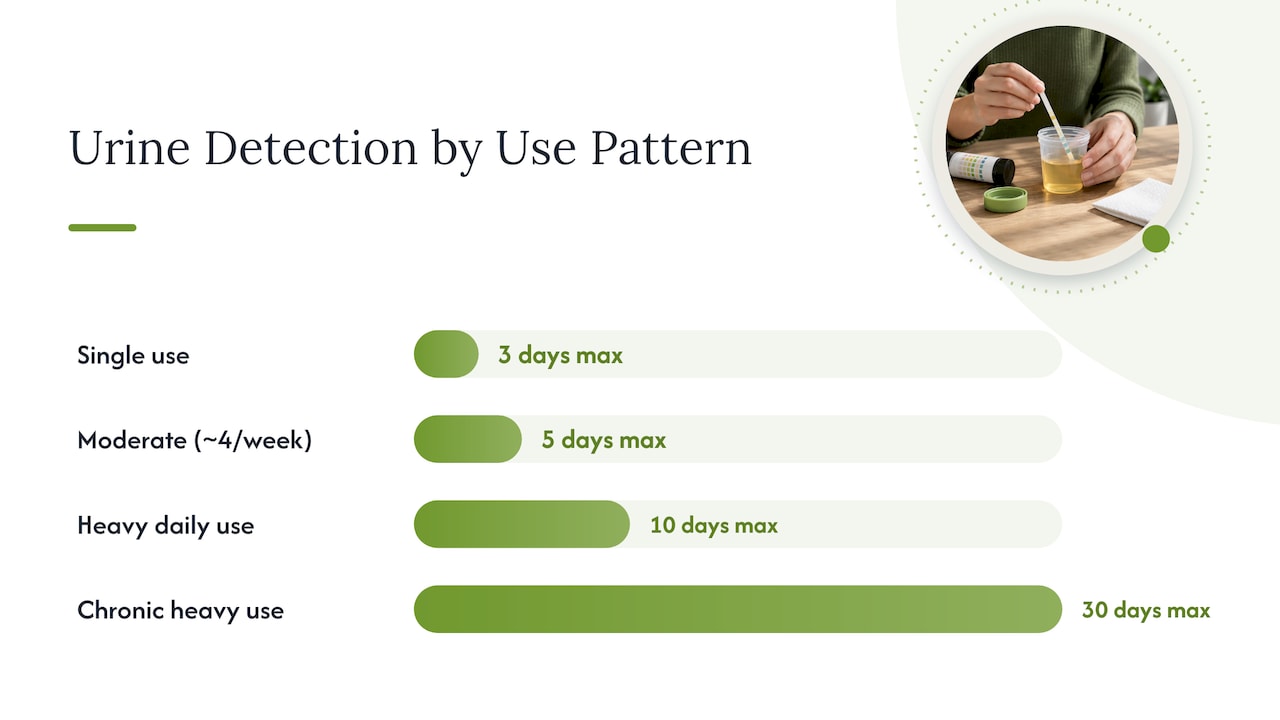
For most people, weed stays detectable in urine for about 3 days after a single use. With regular use it can be 5 to 10 days, and daily heavy users can stay positive for 30 days or longer. These are estimates, not promises. The number that matters most is how often you have used cannabis, followed by the cutoff the lab applies to your sample.
Below, you will find the ranges laboratories publish, why two people can get different results after the same last use, what a federal cutoff means in practice, and which popular shortcuts do not hold up.
TL;DR
- Typical urine windows: up to about 3 days for one-time use, about 5 days for moderate use, about 10 days for heavy daily use, and about 30 days for chronic heavy use, per Mayo Clinic Laboratories.
- Urine tests look for THC-COOH, an inactive metabolite. A positive shows past exposure, not impairment or the exact day you used.
- In federally regulated (DOT) testing, the screen cutoff is 50 ng/mL and the confirmation cutoff is 15 ng/mL.
- Time since last use is the only dependable factor. Water loading, drinks and exercise have not been shown to clear THC-COOH on a schedule.
- Check whether your employer follows DOT rules or its own policy before you assume anything.
Table of Contents
- What a urine test actually looks for
- Detection windows by how often you use
- Why the same last-use date gives different results
- Cutoffs: why “how long” depends on the test
- What the longest windows look like
- Can you clear it in 5 days?
- Hemp and CBD can complicate the picture
- Our perspective
- Keep learning with us
- FAQ
- Sources
What a urine test actually looks for
THC, the compound that makes you feel high, is cleared from the blood quickly. Mayo Clinic Laboratories reports a half-life of under 30 minutes for the parent drug, and it is not what a urine test targets. The test looks for THC-COOH, the main metabolite your liver produces.
That metabolite typically shows up in urine within about 60 minutes of use, though the lab notes it can take as long as 4 hours. This is why a urine result describes history, not the present. The American College of Medical Toxicology explains that the intoxicating effects last hours while the metabolite stays measurable far longer. You can be sober for days and still test positive. We cover this distinction in more depth in our guide to THC metabolites and what tests show.
A urine test also cannot pinpoint when you used. The UW Medicine health library says urine tests cannot show the exact day or hour of last use, because the metabolite lingers after use stops.
Detection windows by how often you use
The table uses the approximate detection times in the Mayo Clinic Laboratories drug reference. Treat each figure as the upper end of what is commonly seen, not a guarantee.
| Use pattern | Approximate urine detection |
|---|---|
| Single use | Up to 3 days |
| Moderate use (about four times a week) | Up to 5 days |
| Heavy daily use | Up to 10 days |
| Chronic heavy use | Up to 30 days |
Source: Mayo Clinic Laboratories. The lab states that dose, frequency and individual metabolism change the result.
Other published ranges differ somewhat. The UW Medicine library says THC can linger up to about 10 days for a casual user. Some consumer pages quote 10 to 15 days for once-daily use. The spread is not an error. It reflects different studies, different cutoffs and real differences between people.
If you want one more estimate to compare, a German-language page on estimated urine detection periods for one-time, occasional, daily and chronic use lays out similar tiers and explains why individual results vary. German rules differ from U.S. ones, so use it for the general pattern only.
Why the same last-use date gives different results
THC-COOH is produced as your body processes THC, and THC is fat-soluble. Frequent use means more stored THC releases slowly back into the blood, so the metabolite keeps appearing in urine. Our guide on how THC stores in fat explains the mechanism and what is and is not supported about speeding it up.
These factors move the window:
- Frequency and duration of use. The biggest factor by far. A weekend user and a daily user of five years are not on the same clock.
- Dose and potency. More THC per session means more metabolite to clear.
- Route. Smoking, vaping and edibles differ in how much THC is absorbed and how fast.
- Body composition and metabolism. These vary person to person. The FDA notes that detection varies significantly with duration and amount of use and with metabolism.
- The test itself. The cutoff, the lab method and whether the result is a screen or a confirmation all change the answer.
- Hydration at collection. It changes how concentrated the urine is. It does not change how much metabolite your body holds.
Controlled research shows how wide the variation can be. A study of chronic users housed in a research unit found some stayed positive for 24.7 days or more, while others cleared in a few days. The ACMT also states that chronic heavy users may have detectable THC-COOH for a month or longer. And a 2026 systematic review of 92 studies reported that weekly-to-daily users could stay above a typical workplace threshold for weeks after stopping.
Cutoffs: why “how long” depends on the test
A lab reports a positive when the metabolite concentration meets or exceeds a set cutoff, not when any trace exists. That is why the same sample can be negative on one assay and positive on another.
For federally regulated workplace testing, the Department of Transportation sets the numbers in 49 CFR Part 40.85:
| Step | Analyte | Cutoff |
|---|---|---|
| Initial (screening) test | Marijuana metabolites | 50 ng/mL |
| Confirmatory test | THCA (THC-COOH) | 15 ng/mL |
A specimen at or above 50 ng/mL goes on to confirmation, and a confirmed result at or above 15 ng/mL is reported positive. That two-step design matters. A sample that screens positive but confirms below 15 ng/mL is not reported as a positive.
Many private employers use similar panels, but they are not bound by the DOT table. A non-DOT employer sets its own policy and picks its own lab, within applicable law. Ask the employer or the testing site which program applies to you. Our guides to U.S. preemployment drug tests and how specimen, cutoffs and program rules change detection times go through those differences. For a broader timeline that also covers hair and saliva, see our THC detox timeline and federal cutoffs.
What the longest windows look like
People often ask for a maximum. No honest single number exists. Heavy chronic users may test positive for a month or longer, and the FDA treats published clearance times as guidelines only. A common mistake is reading “30 days” as a guaranteed ceiling. Some people in studies cleared well before it, and some chronic users exceed it.
The practical reading: if you used once or twice, you are likely clear within days. If you use daily, plan in weeks, and treat any shorter figure as optimistic.
Can you clear it in 5 days?
The honest answer is that nothing medically established guarantees a negative urine test in 5 days, and for frequent or chronic users it is unlikely. Time since last use is the only dependable factor.
Water loading and dilution
Drinking a lot of water can lower the metabolite concentration in a single sample. It does not remove stored THC-COOH. Labs also check specimen validity, so a dilute sample can lead to a recollection or additional review instead of a clean negative. If you are asked to test again, it is often under tighter conditions. Our guide on urine drug test temperature and validity checks shows what collectors check in the first minutes.
Detox drinks, supplements and exercise
Commercial detox drinks, supplements and exercise have not been shown to erase stored metabolite on a predictable schedule. The ACMT notes that hydration changes urine concentration rather than reliably removing accumulated THC-COOH. If you want to understand what these products claim and where the claims stop, read our review of detox drinks for THC drug tests and our explainer on why single-marker quick-fix claims fail. Collection can also be supervised, which we explain in supervised urine collection: your rights and what to expect.
Home tests are not a green light
A negative home test does not guarantee a negative employer test. The FDA says no home-use drug test is 100% accurate and lists testing too soon or too late, the wrong drug panel, expired or poorly stored kits, and concentration differences as reasons a result may not reflect use. A home kit may also use a different cutoff than the lab that handles your sample.
Hemp and CBD can complicate the picture
Hemp and CBD products that contain small amounts of THC can produce detectable THC-COOH. In federally regulated testing, a state medical-marijuana authorization or a hemp-product explanation is not automatically accepted as a legitimate medical explanation for a confirmed positive, per DOT rules on medical review. If you use CBD, read what actually triggers a positive on a CBD and THC drug test before a screening.
Our perspective
We publish drug-testing guides because the most common mistake we see in this topic is a confident number that sounds like a promise. Search results are full of tidy tables, and the tables are not wrong. They are averages of very different people.
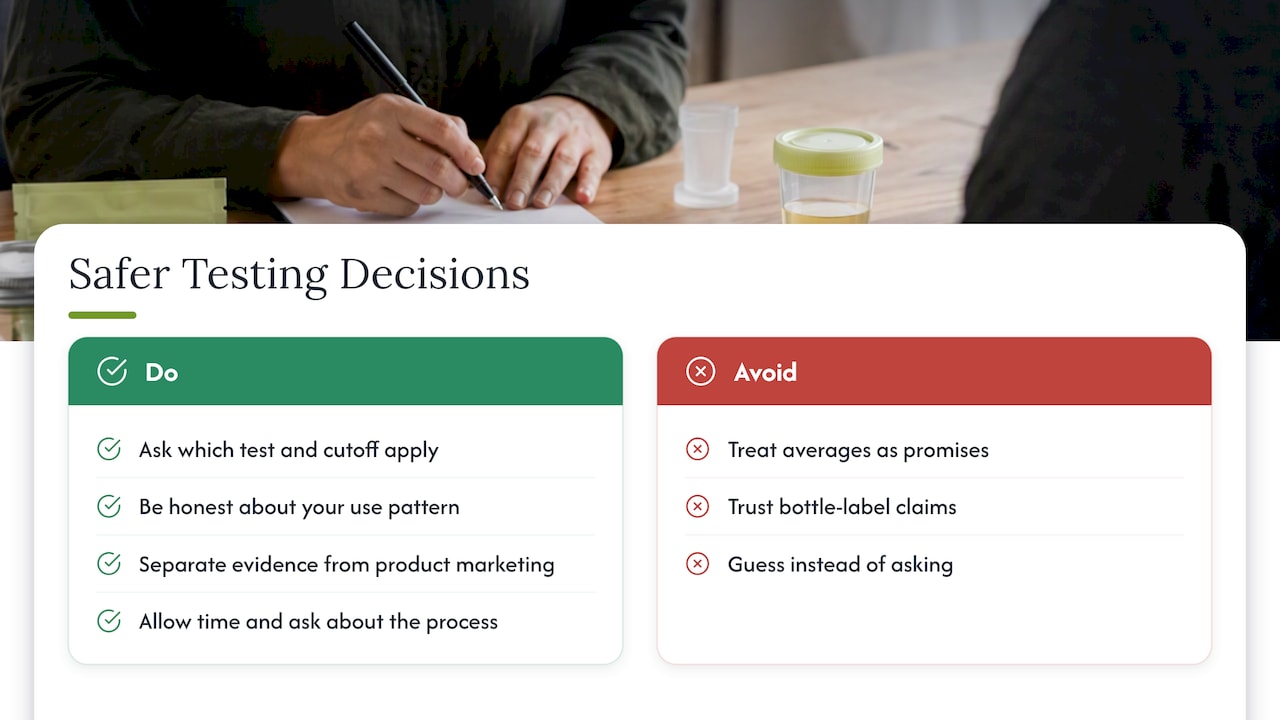
We think readers are better served by three habits. First, ask which test and which cutoff apply to you, because that sets the question before any timeline does. Second, be honest about your own use pattern when you read a range: the low end is for occasional use, and the high end is for people who use often. Third, separate documented testing practice from product marketing. A lab reference, a federal regulation and a medical toxicology position statement can be checked. A claim on a bottle label usually cannot.
If you have a test coming up, the safest plan is the dull one: allow as much time as you can, and ask the employer or a medical review officer what the process is. If you hold a safety-sensitive job, or you use daily, the stakes of guessing are higher, and a conversation with your employer’s testing contact or a clinician is worth more than another timeline.
— MIchael
Keep learning with us
We publish this kind of guide for nurses, nurse scientists and students, and our community includes people who work in testing and patient care. If you want the research and professional resources behind our work, you can explore membership. The individual student plan (undergraduate, master’s and pre-doctoral) is $40 per year, and NSNA members on the discounted individual plan pay $36 per year.
FAQ
What is the longest weed can be detected in urine?
There is no fixed maximum. Mayo Clinic Laboratories lists up to about 30 days for chronic heavy use, and the ACMT says chronic heavy users may stay detectable for a month or longer. The exact limit depends on your use history, your metabolism and the cutoff the lab uses.
How long after weed will I test positive?
The metabolite typically appears in urine within about 60 minutes, and Mayo notes it can take up to 4 hours. So a urine test taken shortly after use may not yet show the full picture. A test taken within a few days of a single use can still be positive.
Can I clear weed from my system in 5 days?
It depends mostly on how often you use. After a single use, 5 days is often enough. For daily or chronic use, it commonly is not, and no drink, supplement or exercise routine has been shown to change that reliably. Excess water can also trigger a dilute-specimen review.
Does a positive urine test mean I was high at work?
No. The test detects THC-COOH, an inactive metabolite, so it shows past exposure rather than present impairment. It cannot tell the lab whether you used last night or several days ago.
Is the 50 ng/mL cutoff the same everywhere?
No. It is the DOT initial cutoff for federally regulated testing. Private employers and labs can use different panels and policies, so ask your employer which program applies.
Sources
- Drug Testing: Marijuana, Mayo Clinic Laboratories
- ACMT Position Statement: Interpretation of Urine for THC Metabolites
- FDA: Drugs of Abuse Home Use Test
- DOT 49 CFR Part 40.85
- DOT 49 CFR Part 40.151
- UW Medicine: Cannabinoid Screen (Urine)
- Extended Urinary THC Excretion in Chronic Cannabis Users (PMC)
- 2026 systematic review on cannabis detection after cessation (PubMed)
Recommended
- THC Metabolites: Tests Show Exposure, Not Current Impairment
- Hours to 90 Days: THC Detox Timeline and 2026 Federal Cutoffs
- Cannabis (THC): How It Stores in Fat and Ways to Flush It Faster
- CBD and THC Drug Tests: What Actually Triggers a Positive
|
The Council for the Advancement of Nursing Science |
   |