Pure CBD is not what a workplace drug test looks for. The test looks for THC or its metabolite, and many CBD products contain a little THC. That trace is the whole risk. A product labeled “THC-free” can still contain enough to cause a positive result, and a federal or DOT-regulated employer will not accept CBD as an explanation.
This guide explains what labs measure, how isolate, broad-spectrum and full-spectrum products differ, where delta-8 fits, and what to do if you have a test coming up.
TL;DR
- Standard U.S. workplace tests target THC-COOH in urine or delta-9-THC in oral fluid, not CBD.
- The risk comes from THC inside the product. Full-spectrum is the highest risk, and isolate is the lowest but not guaranteed.
- Delta-8 THC can produce a positive result on standard THC screens, because the tests do not reliably tell it apart from delta-9.
- In federal and DOT-regulated testing, a medical review officer will not accept “I only used CBD” as a legitimate explanation.
- If a test is near, stopping the product early and asking the employer which panel and specimen apply is the only dependable move.
Table of Contents
- What a drug test actually measures
- Why CBD users still fail
- Isolate, broad-spectrum and full-spectrum compared
- What about delta-8 and delta-8 urine or hair tests?
- Why “it was just CBD” does not work with federal employers
- How long THC lingers if your CBD product was contaminated
- Our perspective: manage the risk you can control
- A practical checklist before a test
- Support the work behind these guides
- FAQ
- Sources
What a drug test actually measures
A THC drug test does not search for cannabidiol. In urine, the compound tested and reported is delta-9-tetrahydrocannabinol-9-carboxylic acid, known as THCA or THC-COOH, according to SAMHSA’s federal workplace testing FAQ. Oral fluid tests look for delta-9-THC itself.
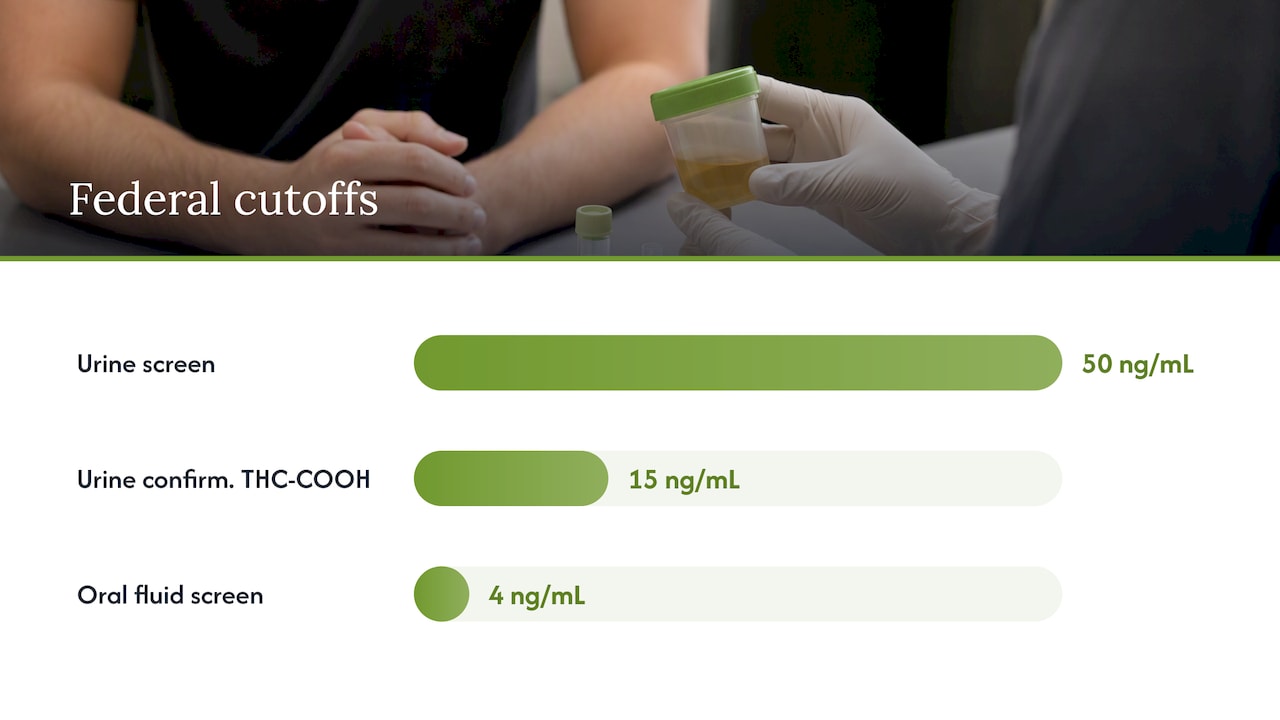
Federal programs use a two-step process. The HHS panels published in the Federal Register on March 13, 2026 set these cutoffs:
| Specimen | Initial screen | Confirmation |
|---|---|---|
| Urine | 50 ng/mL | 15 ng/mL THC-COOH |
| Oral fluid | 4 ng/mL | Confirmation by a second, more specific method |
The first step is a quick immunoassay screen. If it is positive, a lab confirms with a more specific method. That second step matters, because it is what separates a cross-reaction from real THC exposure. Private employers do not have to follow these numbers, but many borrow them. Your actual cutoffs depend on the employer’s policy and the lab they use.
If you want the background on what these metabolites do and do not prove, our guide on THC metabolites and why tests show exposure, not impairment covers it in detail.
Why CBD users still fail
There is no scientific evidence that CBD converts to THC in the human body. The positive results reported after CBD use come almost entirely from THC that was already in the product.
Two things drive that:
- Legal THC. Under the 2018 Farm Bill, hemp-derived products with up to 0.3% delta-9 THC are not marijuana under federal law, as the Department of Transportation notes. Legal does not mean test-proof. That small percentage adds up when you take a high dose several times a day.
- Inaccurate labels. CBD supplements are not standardized. A Johns Hopkins Medicine release cites a 2019 study in which 58 of 84 tested CBD products (69%) were mislabeled. The same release describes a six-person study in which inhaling cannabis with 0.39% THC produced positive urine tests at standard thresholds.
Clinical toxicology guidance, as summarized by Drugs.com, puts the problem plainly: you cannot verify what is in an unregulated supplement. The danger is the supply chain, not the CBD molecule.
What the studies show about dosing
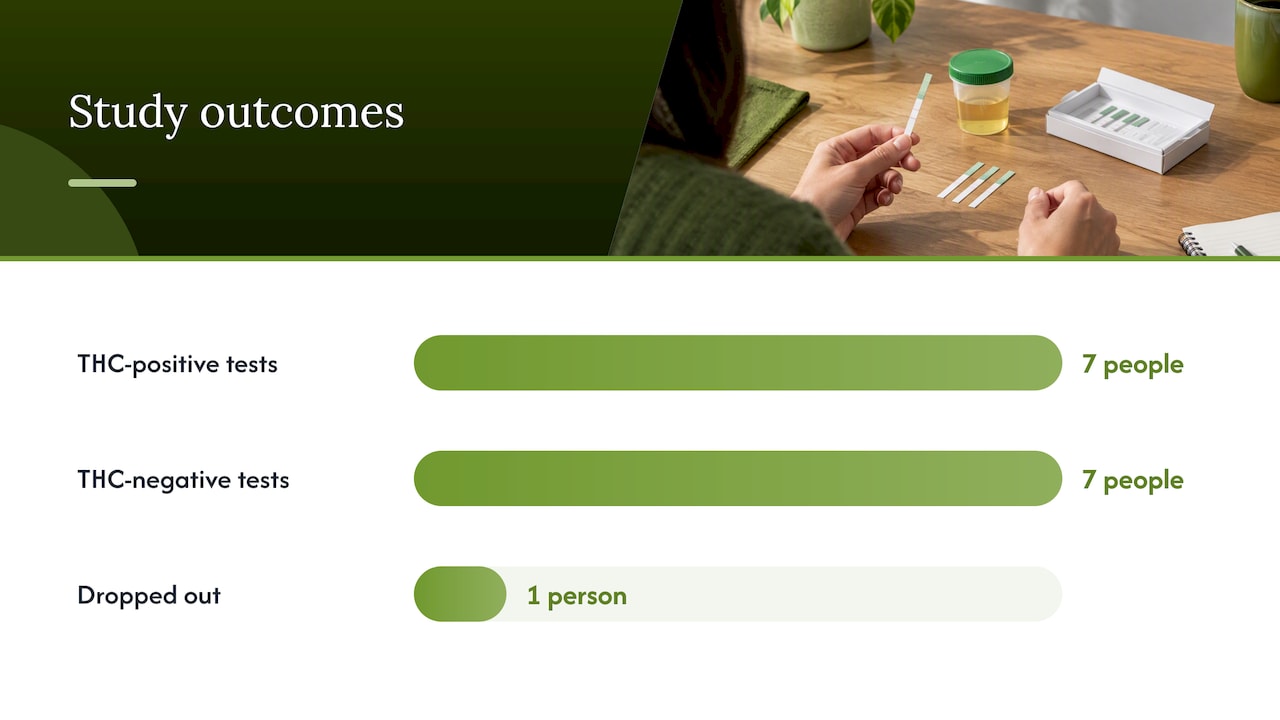
A study reported by Quest Diagnostics from JAMA Psychiatry gave 15 adults a full-spectrum extract three times a day for four weeks. The product contained about 0.02% delta-9 THC. Seven participants tested positive for THC and seven tested negative, and one dropped out. The sample was small, but it shows the risk is real even when the THC percentage looks tiny.
A separate pharmacokinetic study in the Journal of Analytical Toxicology examined urine after oral and vaporized CBD. It is worth reading if you want the lab-level detail on how CBD and THC metabolites appear in urine.
Isolate, broad-spectrum and full-spectrum compared
These labels are not regulated the same way a drug label is, and readers often misread them. Here is how researchers describe the categories, per Drugs.com:
| Product type | What it contains | Relative test risk |
|---|---|---|
| Full-spectrum | Whole-plant extract, including naturally occurring THC | Highest, especially with daily use |
| Broad-spectrum | Multiple cannabinoids with THC reduced or removed | Lower, but trace THC is possible |
| CBD isolate | CBD only | Lowest, the only form theoretically free of THC |
Two cautions apply to isolate. First, “theoretically” is doing real work: cross-contamination during manufacturing can happen, which is why a clean-looking isolate label is not proof. Second, a third-party certificate of analysis is only as useful as the lab behind it and the batch it covers. Check that the batch number on the certificate matches the bottle, and that the report lists delta-9 THC as not detected, not just “below the legal limit.”
Even then, a certificate lowers the risk. It does not remove it.
Vaping, oils, gummies and topicals
Route of use changes how much THC reaches your bloodstream. Oils held under the tongue, gummies and vape cartridges all deliver THC systemically if the product contains it. Topical creams are generally less of a concern for a urine test, but the same label problem applies and we would not stake a job on one. Dose and frequency count the most: a person taking several servings a day builds up more of whatever THC is in the product than someone who uses it once.
What about delta-8 and delta-8 urine or hair tests?
Delta-8 THC is a psychoactive cannabinoid sold in many states as a hemp-derived product. People often assume it is invisible to testing. It is not.
According to Recovered.org’s summary of delta-8 testing, standard urine immunoassays cross-react with delta-8 metabolites, so delta-8 use can give a positive THC result. The body converts delta-8 to a carboxy metabolite much as it does delta-9, and that metabolite can linger for days or weeks depending on how often you use it.
What that means in practice:
- Urine: a standard THC screen may flag delta-8 use. A confirmation test aimed at delta-9 THC-COOH may behave differently from the screen, but you cannot count on that outcome, and an employer may treat a positive as a violation regardless.
- Hair: hair testing looks back about 90 days, and we are not aware of a published, reliable guarantee that delta-8 goes undetected. Treat it as a risk.
- Oral fluid: the same logic applies. If the product contains THC-type compounds, a swab can pick them up.
The SAMHSA Division of Workplace Programs also issued a November 13, 2025 memo on synthetic cannabis-related products to federal agency coordinators and medical review officers. If you work in a federal or federally regulated role, read it or ask your employer’s program how these products are handled.
Why “it was just CBD” does not work with federal employers
If you are in a DOT-regulated job or a federal agency, the rules are strict. The DOT’s CBD notice says the only legitimate medical explanation for a positive THC result is a verified prescription for an FDA-approved cannabis-derived product, such as Epidiolex. A state medical marijuana card or a recommendation to use CBD does not count.
Under 49 CFR 40.151, medical review officers are prohibited from accepting certain explanations, and the DOT’s position on CBD products is that they are not a valid excuse for a positive. The U.S. Customs and Border Protection also publishes its own CBD guidance for employees, which is a good example of an agency that treats the product as the employee’s risk.
If you are a commercial driver, pilot, rail worker or federal employee, the sensible rule is simple: do not use CBD products that are not FDA-approved prescriptions.
How long THC lingers if your CBD product was contaminated
If a product delivers THC, the detection window follows the same pattern as any THC exposure. Typical urine windows reported by Procom Testing:
| Pattern of THC exposure | Typical urine window |
|---|---|
| Single use | 1 to 3 days |
| Occasional (1 to 3 times a week) | 3 to 7 days |
| Moderate (4 to 6 times a week) | 7 to 14 days |
| Daily | 14 to 30 days |
| Heavy daily | 30 to 60 days |
Hair testing reaches back roughly 90 days. These are ranges, not promises. Body fat, metabolism, dose, and the lab’s cutoff all move them. Our guide on the THC detox timeline and federal cutoffs walks through the numbers, and how specimen type and program rules change detection times explains why two people with the same habit can get different results.
Because THC is fat-soluble, it can stay in the body longer for some people. We cover that in how THC stores in fat and what flushing it faster can and cannot do.
Our perspective: manage the risk you can control
We publish drug-testing guides because people usually look this up the week before a test, when the options are narrow. Here is how we see the CBD question.
The honest answer has two parts. CBD alone is not what the test is built to detect. But a person with a screening coming up is not choosing between “CBD” and “nothing”, they are choosing a specific bottle from a market with weak quality controls. That is the part you cannot see from the label.
We also draw a firm line between documented testing practice and product claims. The documented part is short: cutoffs, specimens, windows, and the rule that a medical review officer in a federal program will not accept CBD as a reason. The claims part is long and mostly unverified, and it includes drinks, shampoos and “THC-free” labels that promise more than any lab guarantees.
If a test is close, we would stop the product as early as you can and ask the employer which panel and specimen will be used. Dilution is a poor plan on its own, because labs check for it. According to SAMHSA’s FAQ, abnormal specimen validity results, such as unusual creatinine or specific gravity, can lead to a rejected specimen and a re-collection, sometimes under direct observation. Our pages on supervised urine collection and urine drug test temperature explain what that looks like at the collection site.
If you are still weighing detox products, read our guide to detox drinks for THC tests with the same skepticism we apply here: what is documented, what is claimed, and what depends on your body.
— MIchael
A practical checklist before a test
- Find out the test type. Urine, oral fluid, or hair. Our guide to pre-employment drug tests explains standard five-panel tests and applicant rights.
- Check your rules. DOT, federal, or private employer? A private employer may allow more room to explain a result, but a federal program will not.
- Stop the CBD product. If you cannot be sure of its THC content, the safest choice is to stop well ahead of the test.
- Keep records. Save the product label, batch number, and certificate of analysis. They will not guarantee anything, but they matter if you need to discuss a result with a medical review officer.
- Disclose real prescriptions. Tell the collector and the MRO about any prescription medication, including an FDA-approved cannabis-derived one.
- Ask for confirmation testing. If a screen is positive, a confirmation method is what separates a cross-reaction from true exposure. On probation tests, see our note on asking for GC/MS confirmation.
Hair tests deserve a separate plan, since the window is about 90 days. Our guides to hair dye and drug tests and detox shampoos separate what has been tested from what has only been advertised.
Support the work behind these guides
NursingScience.org is also a professional community for nurse scientists, educators and students. If you work in nursing or are studying for it, you can join as a member. The student rate (undergraduate, master’s and pre-doctoral) is 40 USD per year, and NSNA members pay 36 USD per year at the discounted rate. Employers and schools can also look at the institutional plan on the same page.
FAQ
Will CBD show up on a drug test?
CBD itself is not what standard U.S. workplace tests look for. They target THC-COOH in urine or delta-9-THC in oral fluid. A positive result after using CBD usually means the product contained THC.
Is there CBD that won’t show up on a drug test?
No product can be promised safe. CBD isolate is the only form theoretically free of THC, but manufacturing cross-contamination and mislabeling are documented problems. Broad-spectrum may contain trace THC and full-spectrum usually does, so chronic users face the highest risk with those.
Does delta-8 show on a drug test?
It can. Standard urine immunoassays cross-react with delta-8 metabolites, so a THC screen may come back positive. Do not assume that a confirmation test will clear you, and do not assume hair or oral fluid tests will miss it.
Can I use CBD as a medical excuse for a positive result?
Not in federal or DOT-regulated testing. The DOT says a state medical marijuana card or a CBD recommendation is not a legitimate medical explanation. Only a verified prescription for an FDA-approved cannabis-derived product, such as Epidiolex, qualifies.
Will I fail if I used CBD two weeks ago?
It depends on how much THC the product contained, how often you used it, and which specimen is tested. Light, infrequent exposure often clears urine within days, while heavy daily exposure can take weeks. Ask the employer which test applies, and talk to the MRO if a result is positive.
Sources
- Federal Register, March 13, 2026: HHS drug testing panels
- SAMHSA: Federal workplace drug testing FAQ
- SAMHSA memo on synthetic cannabis-related products, November 13, 2025
- Johns Hopkins Medicine: Some CBD products may yield cannabis-positive urine drug tests
- U.S. DOT: CBD notice
- U.S. DOT: 49 CFR 40.151
- U.S. Customs and Border Protection: CBD, know the facts
- Drugs.com: Does CBD show up on a drug test?
- Quest Diagnostics: Full-spectrum CBD may trigger positive THC result
- Journal of Analytical Toxicology: urinary pharmacokinetic profile of CBD, THC and metabolites
- Recovered.org: Delta-8 THC drug test detection
- Procom Testing: drugs tested on a 10-panel
Recommended
- THC Metabolites: Tests Show Exposure, Not Current Impairment
- Best Detox Drinks for THC Drug Tests: A Comprehensive Guide
- Cannabis (THC): How It Stores in Fat and Ways to Flush It Faster
- Hours to 90 Days: THC Detox Timeline and 2026 Federal Cutoffs
|
The Council for the Advancement of Nursing Science |
   |