Short answer: yes, cosmetic hair treatments can lower detectable drug concentrations in some cases, but they do not reliably guarantee a negative hair follicle test. The effect depends heavily on the drug type, how damaged the hair already is, and which lab protocol gets applied. The sections below walk through how hair testing actually works, what the peer-reviewed studies found, and what you can realistically expect if you are facing one.
TL;DR:
- Hair bleaching and aggressive chemical treatments can significantly reduce drug concentrations, but do not reliably produce a negative test result at standard cutoffs.
- Large population studies show dyed or chemically treated hair still tests positive about as often as untreated hair, indicating dyes are not a dependable workaround.
- The measured reduction in drug levels from cosmetic treatments varies widely depending on application frequency, hair condition, and drug type tested, with no guaranteed effect.
- Labs typically inspect hair for damage and chemical signs before testing and may use biomarkers to detect manipulation, which can influence result interpretation.
- Confirmatory testing with advanced methods is available if manipulation or false positives are suspected, but no simple cosmetic procedure guarantees a pass.
Table of Contents
- How hair drug testing works: biology, sampling window, and lab workflow
- Which cosmetic hair treatments and routines affect results
- What the research shows: key studies, results, and limitations
- How labs detect treatment, screen for manipulation, and interpret treated samples
- Practical advice: what you can and can’t rely on before a hair test
- Legal and privacy considerations related to hair drug testing
- Impact of hair type and ethnicity on drug test accuracy
- Time required for hair drug test results to be reported
- Separating lab evidence from internet claims
- Where to go next for hair testing guidance and professional resources
- FAQ
- Sources
How hair drug testing works: biology, sampling window, and lab workflow
Hair testing works because drugs and their metabolites travel from your bloodstream into the hair follicle as the strand forms, becoming locked into the hair shaft as it grows. Some researchers also point to a secondary route: external exposure through sweat and sebum can deposit trace amounts onto the hair surface, which is one reason washing protocols matter so much before analysis.
A standard head hair test typically uses a sample cut close to the scalp, and labs usually analyze a segment that corresponds to roughly the past 90 days of growth, since hair grows at a fairly predictable rate. That 90-day window is the main reason hair testing is favored for programs that want a longer look-back than urine or saliva can offer.
Collection follows fairly rigid rules. According to the Hair Collection Manual, collectors need a minimum hair mass and length, with strands aligned at the root end, sealed on a collection card or foil, and secured with tamper-evident seals to preserve chain of custody. When someone does not have enough head hair, body hair can serve as a substitute, though body hair grows more slowly and complicates the standard 90-day interpretation.
Once a sample reaches the lab, it goes through a two-step analytical process:
- Screening: an immunoassay technique, commonly ELISA, flags samples that may contain drug residues above a preliminary threshold.
- Confirmation: presumptive positives move to gas chromatography-mass spectrometry or liquid chromatography-tandem mass spectrometry, which identify and quantify specific metabolites with much greater precision.
This two-tier approach exists specifically to filter out false positives from the initial screen, since GC-MS and LC-MS/MS testing is far less prone to cross-reactivity with unrelated substances.
Which cosmetic hair treatments and routines affect results
Not every treatment has the same effect, and the differences matter if you are trying to understand what actually changes a lab result. Oxidative processes, meaning bleach and strong lightening treatments, tend to produce the largest reductions because the chemistry that opens the hair cuticle to lift color also breaks down trapped drug metabolites. Permanent dye, chemical perming, and thermal straightening can produce similar but generally smaller effects, and the outcome varies by which drug is being tested for and how much cumulative damage the hair has already sustained.
Washing habits matter too. Repeated aggressive washing, along with commercial products marketed as hair detox shampoos, has shown inconsistent results across studies: some produced only modest reductions, while others produced sharp drops in measured concentration. A controlled study on commercially available manipulation products treated THC-positive hair with substances including vodka, a hair tonic, a disinfectant, and over-the-counter shampoo, and found mean reductions of about 52% to 65%, with some treated samples dropping below the reporting threshold entirely.
That sounds like strong evidence for a “detox” strategy, but the same body of research complicates the picture:
- Reductions that large generally required repeated, aggressive application, not a single quick rinse the night before a test.
- Even sizable percentage drops did not uniformly push every sample below the cutoff, since starting concentration varies from person to person.
- Large population studies looking at thousands of real-world samples have found that dyed hair often still tests positive at standard forensic cutoffs, which contradicts the idea that coloring your hair is a dependable workaround.
That last point deserves emphasis, because it is where internet advice and laboratory science diverge. A single controlled experiment describing a 60% reduction is a real finding, but it describes a best-case lab condition, not a guarantee that applies to your hair, your usage history, or the specific drug panel being run. For step-by-step guidance on preparation methods that have actually been tested, our methods to pass a hair drug test guide breaks down what has and has not shown measurable effects.
What the research shows: key studies, results, and limitations
The strongest peer-reviewed evidence on cosmetic treatment and hair testing comes from a mix of small controlled lab experiments and much larger population studies, and the two types of research tell different stories.
A reduction of 52% to 65% in measured THC levels was the mean effect across treated samples in a controlled study of commercial manipulation products, with some samples falling below the reporting threshold after repeated treatment. That is a meaningful effect size, and it is the figure most often cited by sites promoting detox shampoos.
But a separate line of research complicates any simple takeaway. A large-sample analysis comparing roughly 9,488 untreated hair samples against 1,026 cosmetically treated samples, described in research on the utility of colored hair for drug detection, found no significant difference in positivity rates for many analytes at standard forensic cutoffs. In plain terms, dyed hair in that dataset was still catching positive results about as often as untreated hair.
Treated hair is often a usable matrix for forensic drug detection, and cosmetic processing alone does not reliably eliminate positive results at standard cutoffs.
The gap between these findings comes down to study design. The 52% to 65% reduction came from a controlled lab setting where researchers applied specific products under specific conditions to hair with known starting concentrations. Real-world population data reflects an uncontrolled mix of dye brands, application frequency, hair condition, baseline drug exposure, and time between treatment and testing, which is exactly the kind of variability that tends to wash out a dramatic lab effect.
A few limitations are worth keeping in mind whenever you see a detox study cited as proof of a method:
- Many of the strongest reduction studies use small sample sizes, sometimes a few dozen hair specimens, which limits how confidently the results generalize.
- Several experiments rely on in vitro exposure, meaning drug-spiked hair treated in a lab, which may not behave identically to hair with naturally incorporated drug residue from months of actual use.
- Older studies often lack multivariable control for hair color, texture, or baseline concentration, making it hard to isolate the treatment’s true effect.
- Results vary meaningfully by drug class, so a reduction seen for THC does not necessarily apply to opioids, cocaine, or amphetamines.
Put together, the evidence supports a real but inconsistent effect, not a dependable method.
How labs detect treatment, screen for manipulation, and interpret treated samples
Labs do not simply accept a hair sample at face value. Technicians typically perform a visual inspection first, documenting obvious signs of bleaching, coloring, or chemical damage before the sample ever reaches instrumentation. Every sample also goes through a wash step designed to strip away external contamination, sweat, oils, or environmental residue, so that what gets measured reflects drug incorporated into the hair rather than surface exposure.
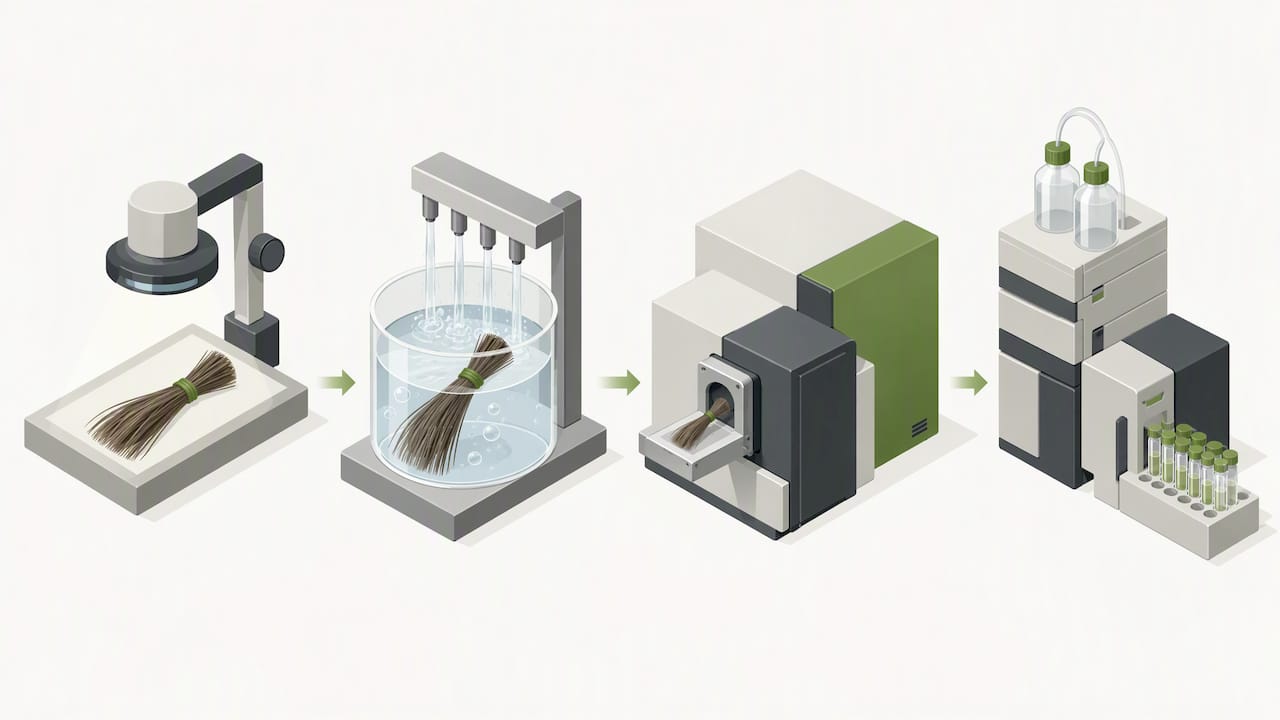
Confirmatory testing then focuses on specific metabolites rather than parent compounds where possible, since metabolite presence is harder to explain away as incidental exposure, and labs apply cutoffs recommended by professional bodies such as the Society of Hair Testing to decide what counts as a positive result.
Detecting manipulation itself is an evolving area. A recent review of advances in testing for sample manipulation describes emerging biomarkers, including a compound called PTCA that can indicate oxidative damage consistent with bleaching, along with infrared and fluorescence microscopy techniques that can flag altered hair structure. These methods are promising but not yet standardized across every laboratory, so their use still varies by provider.
A few practical patterns show up across labs handling treated hair:
- Visibly bleached or chemically damaged hair often gets noted in the chain-of-custody record, which can factor into how a result gets interpreted.
- Oxidative markers like PTCA are increasingly used to flag possible bleaching, though interpretation has to account for natural variation in melanin content across different natural hair colors.
- When a lab suspects manipulation or receives an ambiguous result, it may request a complementary urine test rather than relying on hair alone.
Pro Tip: If you know your hair has been recently bleached or chemically treated, mention it before testing rather than after. A flagged, documented condition is treated very differently from an unexplained anomaly discovered later.
Practical advice: what you can and can’t rely on before a hair test
If you are facing an upcoming hair follicle test, a handful of steps are grounded in how labs actually operate, while a lot of popular advice is not.
- Disclose any prescribed medications that could produce a legitimate positive, since this context matters for interpretation and can be documented ahead of time.
- Confirm which hair segment and sample source will be used, since head hair, body hair, and different segment lengths produce different detection windows.
- Ask about supervised or alternative testing options if you have a legitimate concern about accuracy, since some programs allow urine or saliva as a complement or alternative in specific situations.
What you should not count on is a single dye job, bleach treatment, or internet detox recipe functioning as a guaranteed pass. The research reviewed above shows real percentage reductions under controlled lab conditions, but population-level data shows plenty of treated hair still testing positive at standard cutoffs. Treating a forum post or product label as equivalent to peer-reviewed evidence is where most people get into trouble.
If you believe a result is a false positive or suspect your sample was mishandled, you can request confirmatory metabolite testing, since GC-MS and LC-MS/MS confirmation is specifically designed to resolve ambiguous screening results. For a workplace or legal situation, it is also reasonable to seek occupational or legal guidance before accepting a disputed result. Our broader guide on how to pass a drug test compares hair, urine, and saliva options if you are weighing which test type applies to your situation.
Pro Tip: Keep documentation of any chemical treatments, including dates and products used, in case you need to explain hair condition to a tester or in an appeal.
Legal and privacy considerations related to hair drug testing
Hair drug testing sits at the intersection of employment law, privacy expectations, and laboratory accreditation standards, and the rules governing it vary by context. Workplace testing programs are typically governed by employer policy and, where applicable, state and federal regulations that specify how samples can be collected, stored, and used in employment decisions. Chain-of-custody documentation exists partly for this reason: a defensible result depends on a clear, unbroken record of who collected the sample, how it was handled, and who performed the analysis.
Privacy concerns also come up around what a hair sample can reveal. Unlike urine, which reflects a narrower recent window, hair can capture months of history, which raises legitimate questions about how much historical information a single test should expose and how that data gets stored or shared afterward.
If you are asked to undergo hair testing in a legal, custody, or employment dispute, it is worth understanding who has access to the results, how long records are retained, and whether you have the right to request a retest or confirmatory analysis. These specifics depend on the testing program and jurisdiction involved, so general guidance cannot substitute for a direct answer from the organization requesting the test or, where stakes are high, a professional with relevant legal expertise.
Impact of hair type and ethnicity on drug test accuracy
Hair structure and pigmentation are not neutral factors in drug testing, and this has been a long-running concern in forensic toxicology. Darker, coarser hair generally contains more melanin, and some research has suggested that melanin can bind certain drug compounds, particularly basic drugs, more readily than it does in lighter or finer hair. That raises the possibility that two people with identical drug exposure could show different hair concentrations purely based on hair pigmentation.
This matters practically because cosmetic treatment effects are not uniform across hair types either. Bleaching chemically damaged, coarse hair may behave differently than it does on fine, previously untreated hair, which is part of why lab studies on manipulation products show a range of outcomes rather than one consistent number.
This is also an active area of scientific and legal discussion, since any systematic bias based on natural hair characteristics raises fairness concerns in settings like employment screening or criminal justice. Labs that rely on hair testing are generally aware of this literature, and professional body guidance continues to evolve as more research clarifies how much of an effect pigmentation actually has once modern extraction and confirmation methods are applied. If sample integrity or hair type is a concern in your situation, understanding proper collection technique can help. A partner resource on hair root collection walks through why root-end sampling matters for test accuracy, a principle that applies across both paternity and drug testing contexts.
Time required for hair drug test results to be reported
Turnaround time for hair drug testing depends on whether a sample needs confirmatory analysis after the initial screen. A negative screening result, meaning no drug flagged above the immunoassay threshold, often gets reported fairly quickly since no further testing is required. A presumptive positive screen, on the other hand, triggers the confirmatory GC-MS or LC-MS/MS step, which adds processing time because it involves more precise, slower instrumentation.
Exact timelines vary by laboratory, sample volume, and whether testing is handled in-house or sent to a reference lab, so anyone facing a real deadline, such as a job offer contingent on results, should ask the specific testing provider or employer directly rather than assuming a fixed number of days. What is consistent across providers is the two-step logic: screening first, confirmation only when needed, which is part of why confirmed positive results generally take longer to report than straightforward negatives.
Separating lab evidence from internet claims
Our approach to this topic starts with peer-reviewed studies and professional guidance, then flags where popular detox advice goes beyond what that evidence supports. For deeper, tested detail on preparation methods and supervised collection, see our guides on methods to pass a hair drug test and supervised drug testing.
— MIchael
Where to go next for hair testing guidance and professional resources
If you want the practical, tested detail behind the research summarized here, our methods to pass a hair drug test guide and our tested products and methods roundup go deeper into what specific products did and did not accomplish in controlled conditions.

For nursing professionals, educators, and students who want ongoing access to research-based resources like this one, membership with NursingScience includes student pricing at $40 per year and a discounted rate of $36 per year for NSNA members.
FAQ
Will hair dye affect a drug test?
Hair dye and bleach can lower measured drug concentrations in hair, with controlled studies showing mean reductions around 52% to 65% for THC after treatment with certain products. However, large population studies have found dyed hair still tests positive at standard cutoffs about as often as untreated hair, so dyeing is not a dependable way to avoid detection.
Can I pass a hair follicle test in 30 days?
Hair testing typically analyzes roughly the past 90 days of growth, so recent abstinence within a typical short window does not remove drug residue already incorporated into existing hair. Cosmetic treatments or washing may reduce concentrations somewhat, but research shows inconsistent results rather than a reliable method to clear a test in that timeframe.
What can throw off a hair follicle test?
Bleaching, chemical dyeing, perming, and thermal straightening have all shown some reduction in measured drug concentrations in controlled lab studies, with oxidative bleaching generally producing the largest effect. External contamination, hair damage, and inconsistent application are among the variables that make outcomes unpredictable from person to person.
How long will a hair follicle test detect drugs?
A standard head hair sample generally reflects approximately the past 90 days of drug exposure, based on typical hair growth rates and the segment length labs analyze. Body hair can extend the detectable history further but grows more slowly, which complicates precise timeline estimates.
Sources
- Manipulation of THC Hair Concentrations by Commercially Available Products
- Utility of coloured hair for the detection of drugs and alcohol
Recommended
- How to Pass a Hair Drug Test? Tested Method and Products
- How to Pass a Drug Test: A Complete and Detailed Guide
- Methods to Pass a Hair Drug Test
|
The Council for the Advancement of Nursing Science |
   |